
Month: September 2025

CNC plate drilling Machine

CNC plate drilling machines are widely used in industries such as shipbuilding, construction, bridge fabrication, wind tower production, and heavy machinery manufacturing. They are capable of drilling thousands of holes with precise spacing and uniform diameter, which is essential for bolted connections and structural integrity. Many models also include additional features like automatic material feeding, plate alignment systems, and laser or optical positioning units to further increase efficiency and accuracy.

The software used with CNC plate drilling machines allows for CAD or CAM integration, meaning engineers can directly upload digital designs to the machine, and it will execute the drilling sequence exactly as required. This reduces setup time, minimizes waste material, and allows for complex hole patterns that would be nearly impossible to achieve manually. Machines are often equipped with multiple spindles to drill several holes simultaneously, significantly speeding up the production process.

In terms of productivity, these machines are unmatched because they combine speed, precision, and automation. Operators can oversee the process from a control panel, monitor drilling parameters, and make adjustments in real time. The automation also improves safety, as workers do not need to come into direct contact with the drilling area while the machine is in operation. Maintenance of the machine typically involves lubrication, tool inspection, spindle alignment checks, and software updates to keep the system running efficiently.

Overall, a CNC plate drilling machine is a critical asset in modern fabrication facilities, offering high-speed drilling capacity, exceptional accuracy, and the ability to handle large and heavy plates with ease. Its integration of advanced control systems, durable mechanical design, and automated functionality makes it a cornerstone of large-scale industrial manufacturing processes where precision and productivity are equally important.
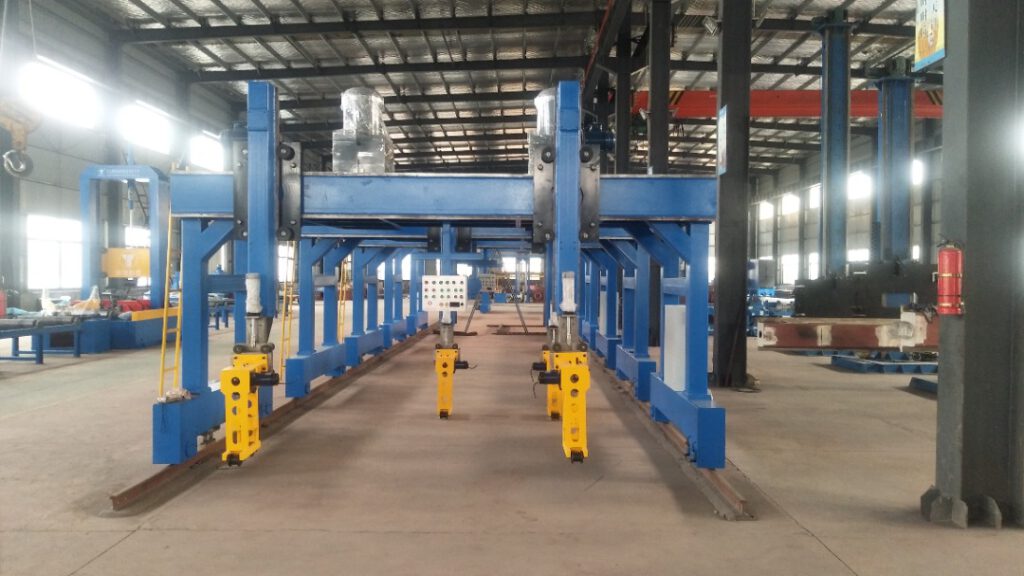
CNC-Plate Drilling Machine

CNC plate drilling machines are widely used in industries such as shipbuilding, construction, bridge fabrication, wind tower production, and heavy machinery manufacturing. They are capable of drilling thousands of holes with precise spacing and uniform diameter, which is essential for bolted connections and structural integrity. Many models also include additional features like automatic material feeding, plate alignment systems, and laser or optical positioning units to further increase efficiency and accuracy.

The software used with CNC plate drilling machines allows for CAD or CAM integration, meaning engineers can directly upload digital designs to the machine, and it will execute the drilling sequence exactly as required. This reduces setup time, minimizes waste material, and allows for complex hole patterns that would be nearly impossible to achieve manually. Machines are often equipped with multiple spindles to drill several holes simultaneously, significantly speeding up the production process.

In terms of productivity, these machines are unmatched because they combine speed, precision, and automation. Operators can oversee the process from a control panel, monitor drilling parameters, and make adjustments in real time. The automation also improves safety, as workers do not need to come into direct contact with the drilling area while the machine is in operation. Maintenance of the machine typically involves lubrication, tool inspection, spindle alignment checks, and software updates to keep the system running efficiently.

Overall, a CNC plate drilling machine is a critical asset in modern fabrication facilities, offering high-speed drilling capacity, exceptional accuracy, and the ability to handle large and heavy plates with ease. Its integration of advanced control systems, durable mechanical design, and automated functionality makes it a cornerstone of large-scale industrial manufacturing processes where precision and productivity are equally important.

H-Beam ASSEMBLY Machine

An H-Beam Assembly Machine is a specialized piece of equipment designed for the precise fabrication of H-shaped steel beams, widely used in construction, bridges, shipbuilding, and heavy structural industries. The

The H-Beam Assembly Machine is an advanced piece of equipment designed to revolutionize the way steel structures are manufactured. It plays a vital role in the production of H-shaped beams, which are widely used in construction, bridges, shipbuilding, industrial plants, and large-scale infrastructure projects. Traditionally, assembling H-beams required extensive manual work, skilled labor, and careful adjustments to ensure accuracy, but this machine simplifies the process by combining hydraulic clamping, automatic centering, and tack welding into one streamlined system.

During operation, the web plate is placed on the machine while the flange plates are positioned on either side. Once in place, the machine uses its hydraulic clamping system to hold the components tightly, ensuring that the web and flange maintain the exact ninety-degree angle necessary for structural integrity. The advanced centering mechanism further guarantees perfect alignment, eliminating errors that commonly occur in manual assembly. After the plates are securely clamped, the machine’s tack welding heads engage and weld both sides simultaneously. This process locks the components in place and prevents distortion during the subsequent full welding stage, often performed by submerged arc welding machines.

Built with a heavy-duty frame, the H-beam assembly machine is capable of handling beams of different sizes and thicknesses, making it highly versatile for various industrial requirements. It not only improves assembly accuracy but also dramatically increases production efficiency, reducing the time required to prepare beams for welding. By delivering consistent results and maintaining dimensional precision, the machine enhances the overall quality of steel structures, ensuring beams are strong, reliable, and suitable for demanding applications.

H-Beam Straightening Machine

An H-Beam Straightening Machine is a heavy-duty industrial equipment designed to correct bending, distortion, and deformation in welded H-beams, I-beams, and other structural steel sections. During the welding process, beams often become warped due to thermal stress, which reduces accuracy and quality. This machine uses powerful hydraulic or mechanical rollers to apply controlled pressure on the flanges of the beam, restoring them to the required straightness.


Equipped with high-strength rollers, robust hydraulic cylinders, and an automatic feeding system, the machine ensures fast and precise straightening with minimal manual intervention. It can handle a wide range of beam sizes and thicknesses, making it highly versatile for steel fabrication plants, construction industries, and shipbuilding yards.

Detailed Description of H-Beam Straightening Machine
The H-Beam Straightening Machine is a specialized piece of equipment used in steel structure fabrication workshops to correct the deformations that occur in the flanges of H-beams, I-beams, and similar structural profiles during the welding process. When beams are manufactured and welded, uneven heating and cooling create internal stresses, causing bending, twisting, or warping in the flange areas. These deformations not only affect the dimensional accuracy of the beam but also compromise the structural integrity and ease of assembly. The H-Beam Straightening Machine is designed to eliminate these issues efficiently.
This machine operates on either hydraulic or mechanical pressure systems to apply powerful and controlled force through hardened straightening rollers. The rollers press against the deformed beam flanges, gradually correcting them to the required tolerance. The equipment is capable of handling different beam sizes, flange thicknesses, and degrees of deformation, making it highly versatile in modern steel fabrication industries.